

Blog
UHF Vs VHF Radios: Which Frequency Works Best For You?
If you have ever bought a set of radios for your church, warehouse, or security team and found they worked perfectly in the parking lot but failed the moment you walked into the basement, you have likely experienced the battle of UHF vs VHF.
Choosing the right radio isn’t just about buying the most expensive Motorola model; it is about physics. The frequency you choose dictates whether your signal can punch through a concrete wall or travel five miles across a flat farm.
In this guide, we will break down the differences between UHF (Ultra High Frequency) and VHF (Very High Frequency). We will help you decide which system will keep your team connected, safe, and efficient—whether you are managing a high-rise hotel or a sprawling outdoor festival.
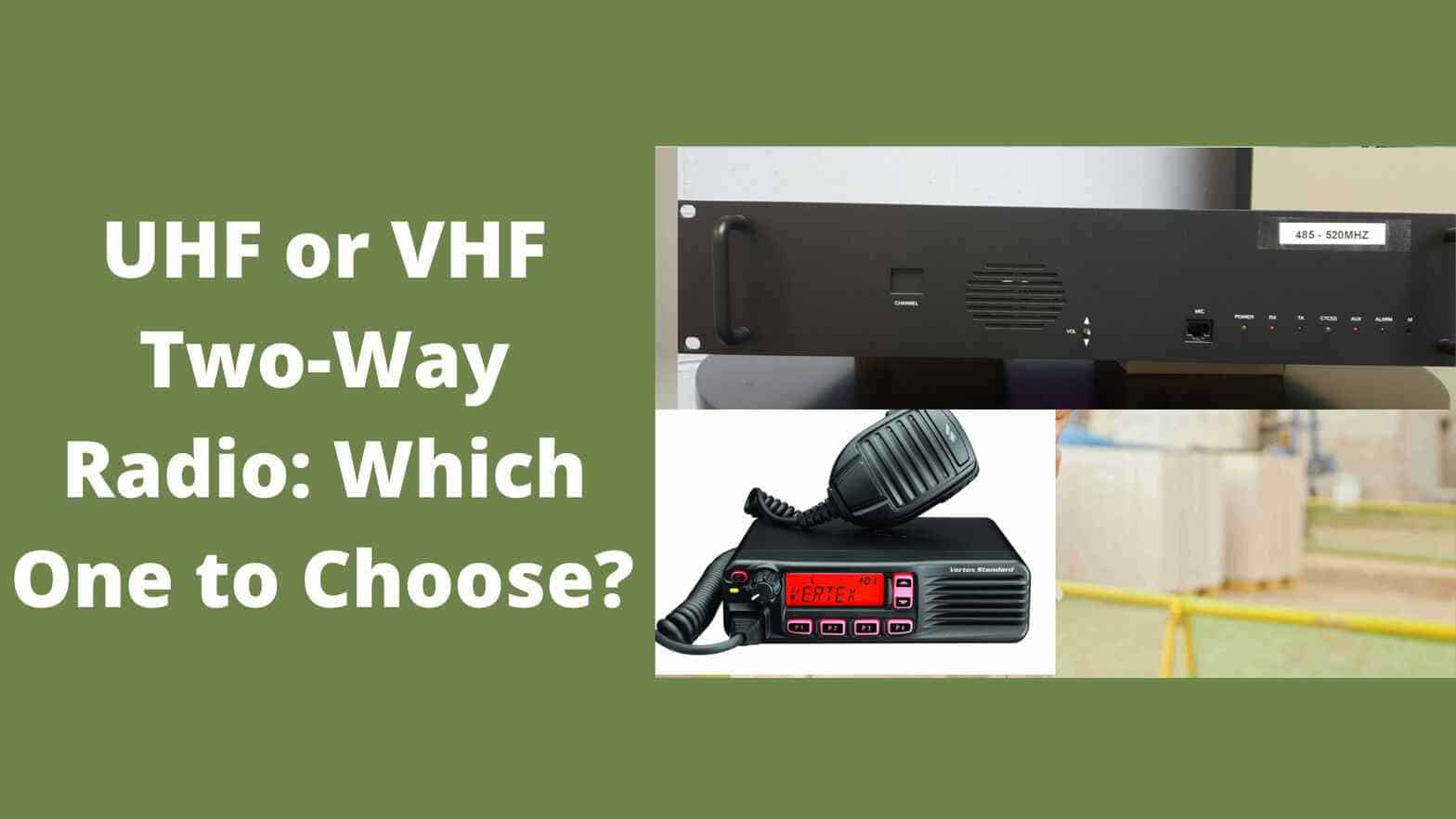

Key Takeaways
UHF (Ultra High Frequency) is best for indoor use, penetrating concrete, steel, and walls efficiently.
VHF (Very High Frequency) reigns supreme outdoors, offering longer range in open terrain and over water.
FCC Licensing is often required for business radios (Part 90), while some personal bands (like FRS) are license-free.
Antennas Matter: UHF antennas are short and stubby; VHF antennas are longer and more flexible.
Motorola Solutions offers robust models in both bands, such as the CP200d (available in both UHF and VHF) to match your specific environment.
Table of Contents
UHF Vs VHF
To understand which radio you need, you first need to understand what these acronyms mean. They refer to the frequency band the radio waves travel on.
VHF (Very High Frequency) operates between 30 MHz and 300 MHz.6
UHF (Ultra High Frequency) operates between 300 MHz and 3 GHz (though most two-way radios sit between 400 MHz and 512 MHz).7
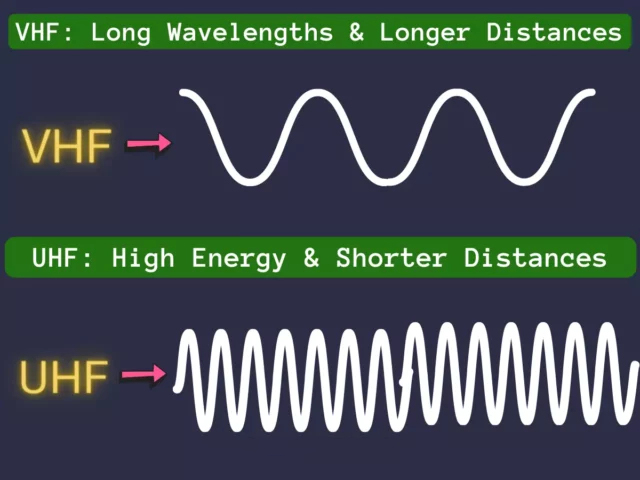
The biggest difference is the wavelength.
VHF waves are longer.Imagine a long, rolling ocean wave. These waves can travel great distances and hug the curvature of the earth, but they crash against obstacles like thick walls or metal structures.
UHF waves are shorter. Think of these like choppy, fast waves. They don’t travel as far horizontally, but they are excellent at squeezing through small openings, doorways, and penetrating building materials.
Historically, VHF was the standard for early broadcast TV and radio because it covered large areas with less power. As cities grew denser and we needed communication inside steel-framed buildings, UHF became the modern standard for urban and indoor business communication.
UHF Vs VHF Radios And How They Differ In Performance?
When you hold a Motorola radio in your hand, the technology inside is tuned to one of these two bands.11 The performance difference is night and day depending on where you stand.
Penetration vs. Range
This is the main trade-off. UHF trades raw distance for “punch.” A UHF signal can push through a 10-story hotel with steel elevators and concrete stairwells.12 A VHF signal might get blocked after two floors. Conversely, if you are on a flat golf course, a VHF signal will glide over the grass for miles, whereas a UHF signal might fade out sooner.13
Interference
VHF shares space with older technologies and can sometimes suffer from interference in crowded electronic areas.14 UHF has more available channels, which is why it is preferred for businesses in busy cities where the airwaves are crowded.15
| Feature | UHF (Ultra High Frequency) | VHF (Very High Frequency) |
| Frequency Range | 300 MHz – 3 GHz | 30 MHz – 300 MHz |
| Wavelength | Short (approx. 12-24 inches) | Long (approx. 1-2 meters) |
| Best Environment | Indoors, Cities, Buildings | Outdoors, Open Water, Fields |
| Penetration | High (Walls, Steel, Concrete) | Low (Blocked by heavy obstacles) |
| Battery Draw | Slightly higher due to frequency | Generally lowe |

Choose the right radio once—and avoid costly coverage gaps.
This breakdown clearly shows why UHF or VHF works better depending on your environment, so buyers do not waste money on radios that fail in real-world conditions.
VHF Vs UHF Radio And Which One Is Right For You?
Choosing the wrong band is the most common mistake new buyers make. Here is how to match the radio to your actual daily needs.
Choose UHF if:
You are a Church Security Team working inside a sanctuary, classrooms, and basement.
You run a Warehouse with metal shelving and forklifts.
You manage a School Campus with multiple brick buildings.
You are in Hospitality (hotels, restaurants) where staff move between floors.
Choose VHF if:
You work in Landscaping or Golf Course Management (mostly open outdoor space).
You are in Agriculture/Farming and need to talk across acres of fields.
You work in Marine/Boating (VHF is the standard for water).
You organize Road Races or festivals in rural areas with few buildings.
Note: If you are unsure, UHF is usually the safer bet for general “mixed” use (some indoor, some outdoor), as it handles buildings much better than VHF handles buildings.
Looking for a versatile solution? The Motorola CP200d is the industry workhorse available in both UHF and VHF versions. Contact us to configure the right one for your site.
Why Is VHF Considered The Best For Certain Applications?
VHF is not “worse” than UHF; it is just specialized. In aviation and marine industries, VHF is the global standard. This is because radio waves travel exceptionally well over water and high in the atmosphere where there are no obstacles.
Additionally, in deep forests or rural hills, VHF waves have a slight ability to “bend” or diffract over terrain features better than the line-of-sight UHF waves. This makes VHF ideal for logging operations or rural public safety where the nearest tower might be miles away.
How Far Can VHF And UHF Range Really Go?
This is the “million-dollar question.” Manufacturers often advertise “up to 25 miles,” but that is under perfect laboratory conditions. In the real world, trees, hills, and buildings cut that range down significantly.
Here is a realistic breakdown of what you can expect from standard 4-watt or 5-watt professional radios:
| Environment | UHF Range Estimate | VHF Range Estimate |
| Inside Buildings | Excellent (covers multiple floors) | Poor (often dead zones) |
| Urban City (Streets) | 1 – 2 Miles | 0.5 – 1 Mile |
| Suburbs (Mixed) | 2 – 3 Miles | 2 – 3 Miles |
| Open Rural/Flat | 3 – 5 Miles | 5 – 7+ Miles |
| Open Water | 4 – 6 Miles | 10 – 20+ Miles |
Real-world range depends heavily on antenna height and power output.
Is UHF Or VHF Better For Communication?
Better is relative. If we define “better” as clarity and reliability, the winner depends on where you are standing.
Indoors: UHF is better. It bounces around hallways and penetrates walls, ensuring you can hear a security alert even if you are in the boiler room. Outdoors: VHF is better. It uses less battery power to push the signal further across open distances.
Battery Efficiency: VHF radios theoretically use slightly less power than UHF radios to transmit the same distance in open air, but modern Lithium-Ion batteries in Motorola radios have largely leveled this playing field.
Why Use UHF Over VHF?
The primary reason to choose UHF is modern construction. Our world is made of steel, concrete, and energy-efficient glass (which often has metal coatings). VHF struggles to get through these layers.
For Law Enforcement and Security in cities, UHF is critical. A police officer or security guard needs their radio to work inside a stairwell, a basement, or an alleyway. UHF provides that coverage reliability where VHF would fade into static.
Which Is Better Between UHF And VHF For Your Organization?
For Schools and Churches: UHF is the winner. You need to connect the parking lot team with the nursery and the sanctuary. UHF handles these walls effortlessly.
For Construction: It depends.
Road crews: VHF (long distances, open air).
Building construction: UHF (navigating through steel beams and concrete cores).
For Warehousing: UHF is essential. Metal racking full of inventory acts like a Faraday cage (a signal blocker). UHF’s shorter wavelength finds the gaps in the racks to keep communication clear.
Do not guess with your budget. We can help you test standard models like the Motorola R2 to see which frequency band provides 100% coverage for your facility.
Are CB Radios VHF Or UHF?
Many people grew up with CB (Citizens Band) radios, famously used by truckers.
CB radios are neither UHF nor traditional VHF. They operate on 27 MHz, which is technically at the very bottom edge of the Low VHF band, but often categorized near HF (High Frequency).
CB Vs VHF And How They Compare?
CB Radio:
Frequency: 27 MHz (Low VHF/HF).
Use: Casual, hobbyist, road talk between truckers.
Pros: No license required.
Cons: enormous antennas required for good range; highly susceptible to static and noise; very poor building penetration.
VHF Business Radio:
Frequency: 136-174 MHz.
Use: Professional, secure, reliable business operations.
Pros: Clear audio, durable hardware, private channels.
Cons: Requires an FCC license.
For a business, a CB radio is not a viable security or operational tool. It is too noisy and insecure.
Can Civilians Use UHF Radios?
Yes, civilians can use UHF, but you must follow the rules.
FRS (Family Radio Service): These are the “blister pack” walkie-talkies you buy at big-box stores. They are UHF, low power (up to 2 watts), and license-free. They are great for camping but not durable enough for daily business use.
GMRS (General Mobile Radio Service): These are more powerful UHF radios. They require a simple FCC license (no test, just a fee) that covers your whole family.
Business Radios (PLMR): If you buy a professional Motorola radio (like the SL300) for your business, you usually need a Part 90 Business License. This ensures you have your own private frequency and do not get interference from the pizza shop next door.
For more on personal radio rules, you can review the FCC Part 95 Personal Radio Services guidelines.
Is It Illegal To Use A VHF Radio On Land?
This is a common point of confusion.
Using Business VHF on Land: Legal (with a license). Many businesses, golf courses, and police departments use VHF on land legally every day.
Using Marine VHF on Land: Illegal. Marine radios (channels 16, 68, etc.) are strictly reserved for water operations. Using a Marine VHF radio on land can interfere with Coast Guard distress calls. It is a federal violation to use a Marine radio for land-to-land communication.
Always ensure your radios are programmed for the correct jurisdiction. Using a marine radio for a hunting trip is a major legal risk.
UHF Vs VHF TV: What’s The Difference?
While we are discussing radios, it is worth noting that TV signals also use these bands.
VHF TV (Channels 2-13): These lower channels require larger antennas (the “rabbit ears” style).27
UHF TV (Channels 14-36+): Most modern Digital TV (DTV) broadcasts are on UHF.28 These signals are easier to pick up with smaller, modern loop or bowtie antennas.
Do I Need A Special Antenna For UHF?
Yes. Because the wavelength is shorter, a UHF antenna is physically smaller.
UHF Antennas: Often look like loops, bowties, or short spikes.
VHF Antennas: Require long rods to “catch” the longer wave.
If you are buying a two-way radio, you will notice UHF antennas are thick and stubby (about 3-6 inches), while VHF antennas are thinner and longer (6-9 inches). Using the wrong antenna on your radio will result in terrible range and could damage the radio.
How To Tell If A Radio Is UHF Or VHF?
If you have a pile of old radios and do not know what they are, here is how to check:
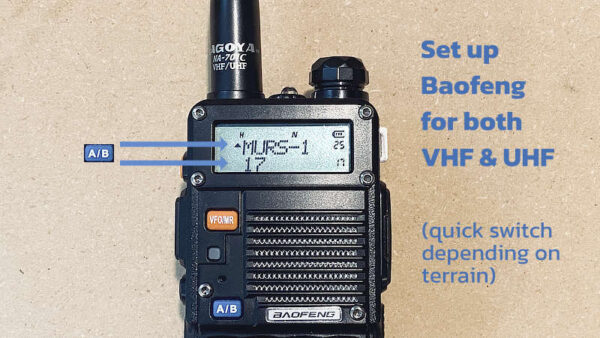
Check the Model Number: Look under the battery. A Motorola model often has a specific code (e.g., “AAH01QDC…” often denotes UHF, while “AAH01JDC…” might denote VHF, though this varies by series).
Check the Antenna:
Stubby/Short (3-4 inches): Almost always UHF.
Long/Whip (6+ inches): Usually VHF.
Google the ID: Type the FCC ID found on the back label into the FCC ID Search tool. This will tell you the exact frequency range.
Device Settings: If the radio has a screen, go to the menu and look for “Frequency.”
If it shows numbers like 462.550, it is UHF.
If it shows numbers like 151.625, it is VHF.
Pros And Cons Of UHF
| Pros | Cons |
| Superior Penetration: Cuts through steel, concrete, and drywall easily. | Lower Outdoor Range: Signal falls off faster in wide-open flat terrain compared to VHF. |
| Compact Antennas: Allows for smaller, more comfortable radios (like the Motorola SL series). | Battery Draw: Slightly higher power consumption to push the higher frequency (negligible in modern devices). |
| More Capacity: The UHF spectrum has more available channels, reducing interference in cities. | |
| Ideal for Buildings: The standard choice for schools, churches, and hospitals. |
Pros And Cons Of VHF
| Pros | Cons |
| Excellent Outdoor Range: Travels furthest in open air, fields, and over water. | Poor Indoor Performance: Struggles to pass through thick walls and steel structures. |
| Efficient: Requires less power to travel long distances line-of-sight. | Interference: The VHF band is more crowded with older pager systems and nearby high-power broadcasters. |
| Cost: Sometimes slightly cheaper equipment (though top-tier brands are priced similarly). | Long Antennas: The antennas can be cumbersome on a belt clip (digging into your ribs). |
| Marine Standard: Essential for any water-based operation. |
Frequently Asked Questions About UHF Vs VHF
What Is The Difference Between UHF Vs VHF Frequencies?
The main difference is the wavelength. VHF (Very High Frequency) has long waves that travel far outdoors but get blocked by buildings. UHF (Ultra High Frequency) has short waves that don’t travel as far outdoors but can wiggle through windows, doors, and walls to give you coverage inside buildings
How Far Can UHF And VHF Radios Transmit?
Handheld to Handheld (UHF/VHF): 1 to 3 miles in typical use.
With a Repeater: If your organization installs a repeater (a high-power booster on a roof), you can cover 10 to 50 miles or an entire city.
Disclaimer: Range is never guaranteed and depends on terrain.