
Blog
Analog Radio: Is It Digital, Are Police Using It And Two-Way Worth It
Your team’s safety depends on clear communication. But choosing between analog and digital radio systems is confusing. Both have real strengths and real weaknesses. Pick the wrong one and you waste budget on equipment your team doesn’t need, or worse, you get static-filled messages during a critical moment. This guide covers how analog radio works, whether police still use it, how DMR compares, and exactly when each technology makes sense for your situation.

Key Takeaways
- Analog radio transmits sound as continuous waves using AM or FM modulation
- Digital radio converts sound into binary data, enabling encryption and error correction
- FM radio is inherently analog and remains broadcast worldwide in analog format
- Police departments are shifting to P25 digital systems for security and clarity
- Digital two-way radios deliver clearer audio and encryption but cost more upfront
- Analog two-way radios remain practical and cost-effective for simple short-range needs
- DMR doubles channel capacity through Time-Division Multiple Access technology
- Migration decisions should factor in team size, environment, and existing infrastructure
- The right choice depends on your specific use case, not industry hype
Table of Contents
Analog Radio
Analog radio is a transmission technology that sends audio as continuous electromagnetic waves. The receiving radio captures these waves and converts them back into sound. In our experience testing two-way systems for commercial clients, the simplicity of this process is exactly why analog has survived for over a century of broadcasting and communication.
Amplitude Modulation (AM) varies the carrier wave’s strength in sync with the sound wave. It uses less bandwidth but picks up electrical interference easily. Frequency Modulation (FM) varies the wave’s frequency instead, delivering cleaner audio. According to the FCC, FM broadcasting operates in the 88 to 108 MHz band and resists amplitude-based noise effectively.
| Feature | AM Radio | FM Radio |
|---|---|---|
| Modulation Method | Varies wave amplitude | Varies wave frequency |
| Audio Quality | Lower fidelity | Higher fidelity |
| Interference Resistance | Low (affected by electrical noise) | High (resists amplitude noise) |
| Typical Use | Talk radio, news, long-distance | Music broadcasting, local stations |
| Bandwidth Required | Narrow (about 10 kHz) | Wider (about 200 kHz) |
| Range Characteristics | Longer range, especially at night | Shorter, line-of-sight focused |
Three factors explain analog’s persistence. Manufacturing costs are significantly lower than digital. The global installed base of analog receivers, estimated at billions of units, creates backward compatibility pressure. And for many use cases, analog’s performance is simply good enough.
What Is Digital Radio And How Does It Differ From Analog?
Digital radio samples analog sound thousands of times per second and converts each sample into binary data before transmission. The receiving radio reconstructs the original sound from this data stream.
The P25 standard used by public safety agencies samples audio at 8,000 times per second using the IMBE codec at 9,600 bits per second. This digital stream can be compressed, encrypted, and error-protected before transmission. The critical advantage is error correction: digital systems filter out noise mathematically.
Analog degrades progressively with more static as distance increases. Digital maintains perfect audio until hitting a reception threshold, then cuts out completely. This “cliff effect” means digital users experience consistently clear audio, though they lose the ability to pick up faint signals at extreme range.
Common digital standards include DAB in Europe, HD Radio in the United States, DMR for two-way communications, and P25 for public safety. Each defines specific sampling rates and codecs tailored to its intended use.
Analog Vs Digital Radio: Which One Performs Better?
A common mistake is comparing these technologies on a single axis. In practice, digital wins on clarity and security, but analog can edge ahead in specific environments.
Audio Quality: Digital delivers consistent audio until the signal drops. Analog picks up static gradually. In noisy industrial settings, digital noise reduction measurably improves comprehension.
Signal Range: Analog weakens gradually and can sometimes be heard faintly beyond its clear range. Digital maintains perfect quality until the cliff, then disappears. In open rural terrain, analog sometimes achieves greater perceived range.
Interference Resistance: Digital systems are dramatically more resistant to electrical noise. Error correction built into DMR and P25 filters out noise that would drown an analog signal.
| Factor | Analog Radio | Digital Radio |
|---|---|---|
| Audio at Range Edge | Static-filled but audible | Clear until cutoff |
| Noise Resistance | Low (no error correction) | High (mathematical filtering) |
| Encryption | None (easily scanned) | Strong encryption available |
| Channel Capacity | One channel equals one call | TDMA doubles capacity |
| Equipment Cost | Lower purchase price | Higher purchase price |
| Programming Complexity | Simple push-to-talk setup | Requires professional programming |
Digital dominates in urban areas, industrial facilities, and hospitals. Analog performs adequately in quiet rural settings where simplicity and low cost matter most.
Confused Between Analog And Digital Radios?
Choosing the wrong radio system can lead to static-filled communication, wasted budget, or critical failures during important moments. Discover which technology actually fits your team’s real-world needs.
Is FM Radio Analog Or Digital?
FM radio is inherently analog. The “FM” stands for Frequency Modulation, an analog encoding method where the carrier wave’s frequency varies continuously to represent sound.
FM continues broadcasting in analog format globally because hundreds of millions of receivers exist in cars, homes, and portable devices. Replacing this infrastructure would cost billions with limited consumer demand driving the switch. According to Nielsen audio data, FM radio still reaches approximately 82% of the U.S. population weekly.
Hybrid approaches like HD Radio transmit analog FM alongside digital sideband signals. Legacy receivers continue picking up the station normally while newer HD Radio receivers access enhanced digital audio and additional subchannels.
Are Police Radios Analog Or Digital?
This question has real public safety implications. The answer depends on the department and its stage of technology migration.
For most of the 20th century, law enforcement communicated through analog two-way radios operating in VHF (136 to 174 MHz) and UHF (380 to 512 MHz) bands. These systems worked, but anyone with a scanner could monitor police transmissions, creating a serious security vulnerability.
The Department of Homeland Security’s SAFECOM program reports that most large U.S. police departments have migrated to P25-compliant digital systems. Many smaller and rural agencies still operate analog due to budget constraints.
Three factors drive the digital shift:
- Encryption prevents unauthorized monitoring, protecting officer safety
- Clearer audio ensures dispatch messages are understood in noisy patrol vehicles
- Spectral efficiency lets multiple agencies share frequencies without interference
Digital Two-Way Radios: Features, Uses, And Advantages
Digital two-way radios operate on standards like DMR, P25, or dPMR. Industries including manufacturing, logistics, healthcare, hospitality, and event management depend on them for secure team communication.
In our experience with logistics clients, digital solves three persistent problems. Audio clarity improves dramatically in noisy warehouses where analog signals become unintelligible. Extended coverage reduces dead zones across large facilities. Encryption protects sensitive operational communications. Many digital models also support text messaging, GPS tracking, and lone-worker emergency alerts.
| Feature | Entry-Level Digital | Professional Digital |
|---|---|---|
| Price Range | $150 to $300 per unit | $400 to $1,200 per unit |
| Encryption | Basic DES encryption | Advanced AES-256 encryption |
| Battery Life | 10 to 14 hours typical | 14 to 24 hours typical |
| Data Features | Voice and basic text | GPS, text, telemetry, alerts |
| Best For | Small teams under 20 users | Large organizations with 50+ users |
Analog Two-Way Radios: Are They Still Worth Using?
Analog two-way radios remain the workhorse of short-range professional communication. UHF analog radios operating in the 400 to 470 MHz range penetrate concrete and steel structures effectively, making them ideal for hotels, warehouses, and commercial buildings.
A practical rule of thumb: if your communication needs are simple, your team is small, and security is not a priority, analog delivers reliable performance at a fraction of digital’s cost. Small retail operations, construction crews, parking management teams, and volunteer event staff are ideal analog use cases.
Compatibility matters too. If you already own analog equipment, adding new units requires no gateway or migration planning.
Are Walkie Talkies Analog Or Digital?
Most consumer walkie talkies sold at retail operate on analog FRS and GMRS frequencies regulated by the FCC. Analog models remain cheaper and simpler. Digital consumer models offer clearer audio but cost more. For casual use, including hiking groups and family outings, analog walkie talkies remain sufficient.
DMR Vs Analog Radio: What Sets Them Apart?
DMR is an open digital standard developed by ETSI, defined in specification TS 102 361. It was specifically designed to improve upon analog systems while maintaining spectrum efficiency.
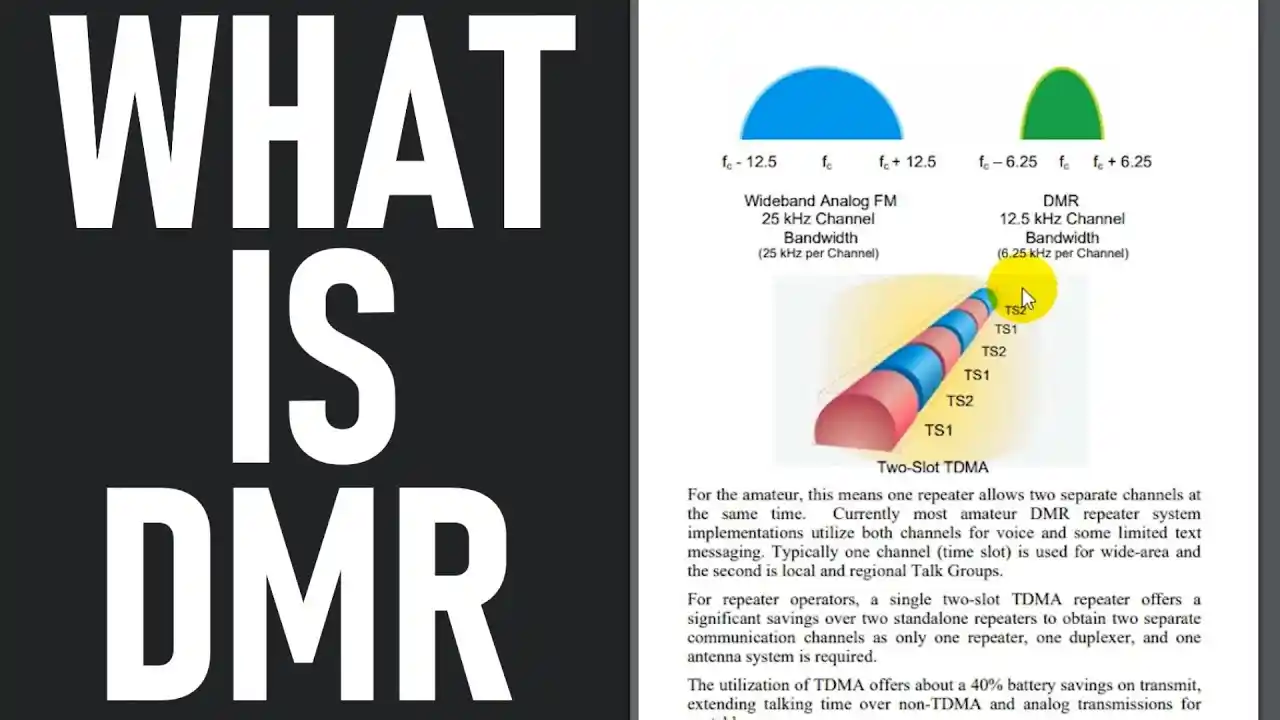
DMR’s defining advantage is Time-Division Multiple Access (TDMA). A standard DMR channel occupies 12.5 kHz of bandwidth, the same as a single analog channel. However, TDMA divides this channel into two alternating time slots, creating two independent voice paths. Two teams communicate simultaneously on what was previously one analog channel. The AMBE+2 voice codec delivers consistent audio with built-in error correction.
Analog remains preferable when maximum simplicity is needed, budgets are extremely tight, or existing infrastructure is entirely analog and user volume does not justify doubling capacity.
What Are The Disadvantages Of Analog Radio?
Analog’s weaknesses are well-documented. Interference and noise from electrical equipment and weather degrade audio progressively. Signal degradation means clarity worsens with distance. No encryption means anyone with a scanner can monitor communications. Spectral inefficiency means one channel carries one conversation, wasting limited frequency resources.
Digital addresses each limitation: error correction eliminates most noise, encryption secures communications, and TDMA doubles channel capacity. The trade-off is higher equipment cost and greater system complexity.
When analog’s “weaknesses” are actually strengths: In quiet rural environments with minimal interference, analog’s gradual degradation is less noticeable. For simple push-to-talk operations where users only need basic communication, analog’s lack of complexity becomes a feature, not a flaw. And when budgets are truly constrained, analog’s lower price point keeps teams communicating rather than waiting for funding.
Is It Really Worth The Cost And Hassle To Migrate From Analog To Digital?
Migration costs include new radios, repeaters, and staff training. The benefits often justify the investment for medium and large organizations.
Our recommendation framework weighs three variables:
- Team size: More than 20 active users per channel benefits from DMR’s doubled capacity
- Environment: Noisy or large facilities gain most from digital clarity
- Infrastructure age: Migrating during scheduled equipment replacement minimizes total cost
Will Radio Ever Become Obsolete?
Radio as a medium will not become obsolete, but it will continue evolving. Industry reports indicate two-way radio remains a multi-billion-dollar market, with digital standards growing annually while analog gradually declines.
Radio’s resilience rests on three structural advantages that streaming and internet platforms cannot replicate. Infrastructure independence means radio works without internet or cell towers. Instant push-to-talk remains faster than any app-based alternative. Emergency reliability keeps radio operational when cellular networks fail during disasters. These advantages keep radio essential in public safety, military, aviation, and maritime operations.
Digital Vs Analog Ham Radio: Which Is Right For You?
Amateur radio offers both analog FM modes on VHF and UHF and digital modes including DMR, D-Star, and Yaesu System Fusion. New operators typically start with analog FM handhelds for affordability and simplicity.
The appeal of digital is global reach. A conversation with another continent using a handheld radio and a personal hotspot is genuinely remarkable. Experienced operators typically maintain both capabilities, choosing based on the situation.
Is Analog Uhf Or Vhf?
Analog radio operates on both bands. UHF (300 MHz to 3 GHz) penetrates buildings effectively and works well indoors and in urban areas. VHF (30 MHz to 300 MHz) travels farther over open terrain with less absorption.
| Band | Frequency Range | Best Environment | Typical Handheld Range (5W) |
|---|---|---|---|
| UHF | 400 to 470 MHz | Indoor and urban areas | 1 to 3 miles |
| VHF | 136 to 174 MHz | Outdoor rural terrain | 3 to 8 miles |
| FRS | 462/467 MHz | Casual consumer use | 0.5 to 2 miles |
| GMRS | 462/467 MHz | Licensed consumer use | 2 to 5 miles |
Frequently Asked Questions About Analog Radio
What Is Analog Radio And Why Is It Still Used Today?
Analog radio transmits audio as continuous electromagnetic waves using AM or FM modulation. It persists because of low manufacturing costs, simple operation, and a massive global installed base of receivers that creates backward compatibility pressure across consumer and professional applications.
Is It Worth The Cost And Hassle To Migrate From Analog To Digital Radio?
Migration is worthwhile if you need encrypted communications, clearer audio in noisy environments, or more channel capacity. If your current analog system works reliably and security is not a primary concern, the investment may not be justified.